

In the current tech landscape, “Generative AI” has become the shorthand for innovation. From creating marketing copy to generating synthetic images, the ability for machines to create has fundamentally changed the corporate conversation.
However, at Bit Developers, we often find that businesses are so focused on the “Generative” side of the coin that they overlook the engine that has been quietly powering the enterprise for years: Discriminative AI.
To build a truly efficient, secure, and AI-native organization in 2026, you need to understand the difference between the two—and more importantly, when to use each.
The Fundamental Difference: Creation vs. Classification
To understand these two paradigms, it helps to look at their core objectives:
-
Generative AI is designed to create new data. It learns the underlying distribution of a dataset so it can generate brand-new instances that look like the original. (e.g., “Write a new email that sounds like my previous ones.”)
-
Discriminative AI is designed to classify existing data. It learns the boundary between different data points so it can tell them apart. (e.g., “Is this email a legitimate business request or a phishing attempt?”)
When Your Business Needs Generative AI
Generative AI is your “Creative Engine.” It is best suited for tasks where the output needs to be novel, fluid, and human-like.
-
Content Production: Automating initial drafts of blogs, technical documentation, or personalized marketing emails.
-
Software Prototyping: Using AI agents to generate boilerplate code or simulate user interfaces during the early stages of a Software Development Sprint.
-
Synthetic Data Generation: Creating “dummy” data for testing environments where privacy regulations (like HIPAA) prevent the use of real customer records.
When Your Business Needs Discriminative AI
Discriminative AI is your “Precision Engine.” It is the workhorse of security and optimization. Because it is focused on boundaries and accuracy rather than creativity, it is often more reliable for high-stakes decision-making.
-
Cybersecurity & Threat Detection: As we highlighted in our post on AI-Powered Phishing, discriminative models are what identify anomalies. They distinguish “normal” network traffic from “malicious” behavior.
-
Predictive Analytics: Forecasting sales trends or predicting hardware failure in an Edge Computing environment.
-
Automated Auditing: Scanning thousands of contracts or logs to flag specific compliance violations.
The Hybrid Strategy: The Bit Developers Approach
The most successful companies in 2026 don’t choose one over the other; they build Hybrid AI Workflows.
Imagine an automated customer service system:
-
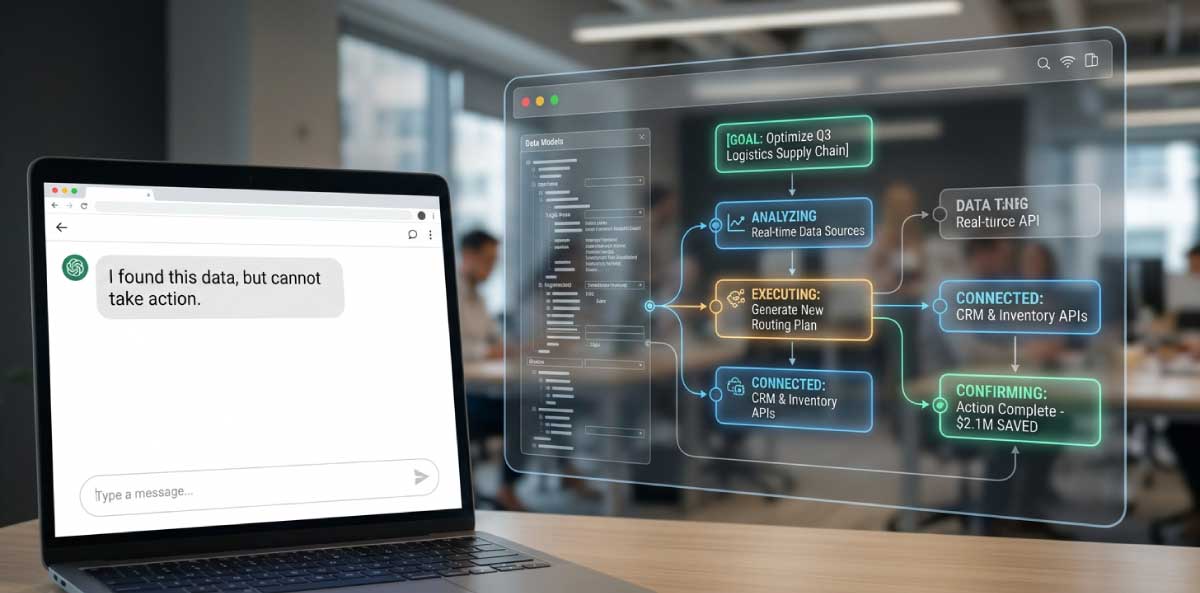
A Discriminative model analyzes an incoming customer query to determine the intent (Is it a complaint? A technical question? A sales lead?).
-
Once the intent is classified, a Generative model drafts a personalized, empathetic response based on that specific classification.
-
Finally, a secondary Discriminative model (an “Auditor”) checks the generated response to ensure it doesn’t violate company policy or provide inaccurate technical specs.
Conclusion: Match the Tool to the Objective
If your goal is to innovate and expand, Generative AI is your best ally. If your goal is to protect, optimize, and verify, Discriminative AI is your most critical asset.
At Bit Developers, we specialize in identifying these nuances. We don’t just “implement AI”—we architect intelligent systems that use the right model for the right task, ensuring your infrastructure is as secure as it is innovative.